


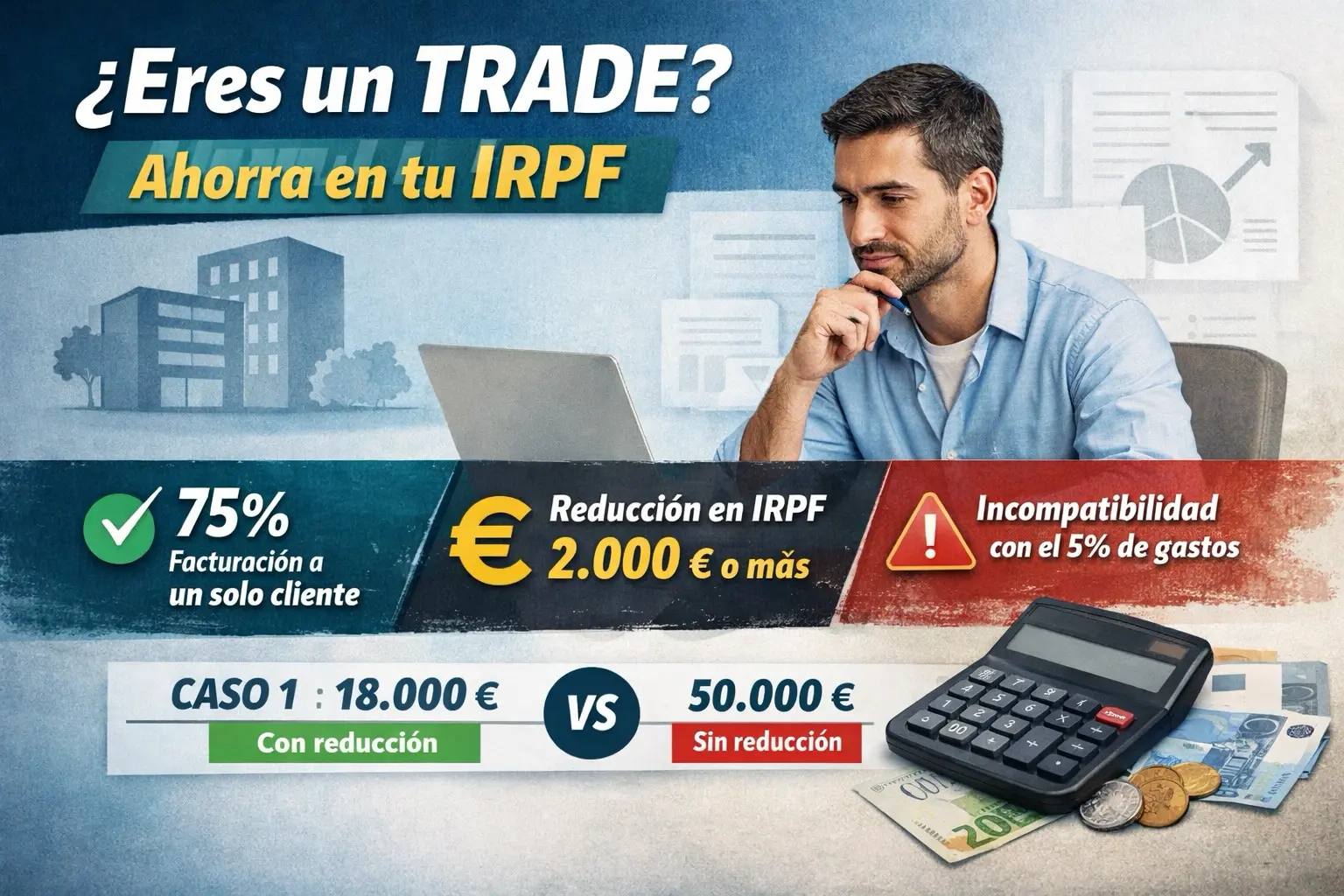
Note for English readers: TRADE (Spain) is a legal status meaning economically dependent self-employed worker(Trabajador Autónomo Económicamente Dependiente). It generally applies when at least 75% of your income comes from one main client.
If you’re self-employed in Spain but most of your income comes from one company, it’s worth checking whether you can be treated as a TRADE (economically dependent self-employed worker) — because it may unlock a specific IRPF reduction.
This is not about “gaming the system”. It’s about applying the rules correctly (and avoiding the classic scenario: discovering the best option after filing… when only your coffee still gives you comfort).
What is TRADE (and why the 75% rule matters)?
A freelancer can be considered economically dependent when a single main client accounts for a very large share of income (commonly referenced as 75% or more). If you meet the legal criteria and formalities, you may fall under TRADE status — and that can connect with a tax reduction under the IRPF rules for “economically dependent or single non-related client” situations.
“Don’t confuse TRADE with false self-employment — here are the key differences.”
The tax benefit: €2,000 IRPF reduction (plus possible extras)
According to the Spanish Tax Agency (AEAT) guidance, the standard reduction is €2,000 per year.
Extra reduction for low net income
If your net income from economic activities is below €19,747.50 and your other non-exempt income (excluding economic activities) is not above €6,500, you may apply an additional reduction:
Net income ≤ €14,047.50: additional €6,498
Net income €14,047.50–€19,747.50: €6,498 − 1.14 × (Net income − €14,047.50)
Extra reduction for disability
If you have a qualifying disability and the net income comes from effective exercise of the activity, the additional amount is:
€3,500, or
€7,750 in certain cases (third-party assistance, reduced mobility, or disability ≥ 65%)
Important: after applying the reduction, the result cannot be negative.
Key eligibility conditions (quick checklist)
AEAT lists several conditions. The ones that most often decide the outcome are:
Net income calculated under direct assessment.
All supplies/services are made to one non-related client, or you qualify as TRADE and the client is not related.
Total deductible expenses across all activities do not exceed 30% of declared gross income.
No employment income in the tax year (with limited exceptions for certain benefits up to €4,000).
At least 70% of income is subject to withholding / payment on account.
No activity via income attribution entities.
The common pitfall: it’s NOT compatible with the 5% allowance (simplified direct assessment)
If you are under simplified direct assessment, you may be used to the 5% “difficult-to-justify expenses” allowance, capped at €2,000.
But you cannot combine that 5% allowance with the TRADE/single-client reduction — you must choose one.
Side-by-side examples (with numbers)
Case 1: Net income €18,000 (simplified direct assessment)
| Concept | 5% allowance | TRADE reduction |
|---|---|---|
| Net income | €18,000 | €18,000 |
| TRADE reduction | – | −€3,992* |
| 5% allowance | −€900 | – |
| Taxable net income | €17,100 | €14,008 |
* €2,000 standard + ~€1,992 low-income extra (using AEAT’s formula).
Case 2: Net income €50,000 + disability (35%)
| Concept | 5% allowance | TRADE reduction |
|---|---|---|
| Net income | €50,000 | €50,000 |
| TRADE reduction | – | −€5,500* |
| 5% allowance | −€2,000** | – |
| Taxable net income | €48,000 | €44,500 |
* €2,000 standard + €3,500 disability extra.
** 5% allowance capped at €2,000.
Practical recommendation for 2026: do not leave it "for May"
Don’t wait until filing season. If you might qualify, review your figures before year-end, confirm eligibility conditions, and run a comparison: TRADE reduction vs 5% allowance.
If you think you can fit as a TRADE, it makes sense to review it before the end of the year:
- Check the actual % of dependence (75% or more).
- Check if you fulfil the tax requirements (expenses ≤ 30%, 70% with withholding, etc.).
- If appropriate, formalise and register the contract (the “formal” part is where people stumble the most).
- Simulate what is more convenient in your case: TRADE reduction vs 5% (and if there are increments, usually the TRADE reduction wins by the go-goat).
FAQs for your blog: TRADE and reduction in personal income tax (autonomous with a main client)
1) What exactly is a TRADE?
A TRADE (economically dependent self-employed worker) is a freelancer who obtains at least 75% of his income from the same client and fulfils a series of legal and formal requirements of this figure.
2) How do I know if I fulfil the “75% with the same client”?
It is calculated with your income/sales of the year: if 75% or more comes from a single customer (usually and on a regular basis), it is convenient to analyse if you fit as a TRADE and if you can document it correctly.
3) Is being TRADE just “a fiscal concept” or does it also have a labour part?
He has both. It is a figure from the labour/self-employed field (Law of the Statute of Self-Employment) with its own requirements and formalities. The tax part (reduction in personal income tax) comes “after”, if you meet the conditions.
4) Do you have to sign and register a TRADE contract?
Yes: normally there must be a written contract and the contract registration with the SEPE within the expected deadlines. (This is where people “fall” the most: 75% is fulfilled but it is not formalised as it touches).
5) What tax savings exist in the personal income tax if I am a TRADE?
In general, there is a fixed reduction of €2,000 per year on the net return of the activity, if you meet the requirements.
6) Can the reduction be greater if I have low incomes?
Yes. If your net returns from economic activities are less than €19,747.50, and you have no other non-exempt income (other than economic activities) greater than €6,500, you can apply an additional reduction:
Yes RN ≤ €14,047.50: €6,498
If RN between €14,047.50 and €19,747.50: it is progressively reduced with the formula indicated by the AEAT.
7) What if I have a disability? Does it also increase?
Yes. There is an additional reduction of €3,500, which can rise to €7,750 in certain cases (third-party assistance, reduced mobility or disability ≥ 65%).
8) I am in simplified direct estimation: can I apply the TRADE reduction and the 5% of “difficult justification” at the same time?
No. They are incompatible: if you apply the reduction for TRADE (or single unlinked client), you cannot apply the 5% of provisions and expenses of difficult justification.
9) So, what suits me better: 5% or the TRADE reduction?
Practical rule:
If your net return is less than €40,000, 5% will be less than €2,000, so the fixed reduction of €2,000 usually comes out better (and even more so if there is an increase due to low income or disability).
If your net return is ≥ €40,000, 5% reaches the top of €2,000, and the difference will depend on whether you can apply increments (for example, disability).
10) What are the most important tax requirements when applying the reduction?
The most “treatious” are usually:
That the set of deductible expenses does not exceed 30% of the full returns declared.
That at least 70% of the income is subject to withholding/income on account.
Fulfil formal obligations and other conditions detailed by the AEAT (and which should be reviewed on a case-by-case basis).
11) What happens if a year does not reach 75% with that client?
If you do not fulfil the requirement in the period, you will not be able to treat yourself as a TRADE that year (and, therefore, you could lose the reduction if it depended on that condition). In practice, it is convenient to plan it before the end of the year and not “discover” it when the Treasury is already warming up engines.
12) Is TRADE and “false self-employed” the same thing?
No. Being TRADE is a legal figure for dependent self-employed. Another thing is when, due to the reality of the service (schedules, integration into the client’s structure, employee’s own instructions, etc.), the relationship may seem labour. If there are doubts, it is convenient to check it, because the problem is not the label: it is the reality. (As at company dinners).
Closure
If you are self-employed and your billing is concentrated on a customer, it is not just a commercial data: it can be a tax lever (well done) or a risk (if it is badly posed). In Asesoría Orihuela Costa we can review it with you and leave it correctly fitted, documented and optimised for your Income.